
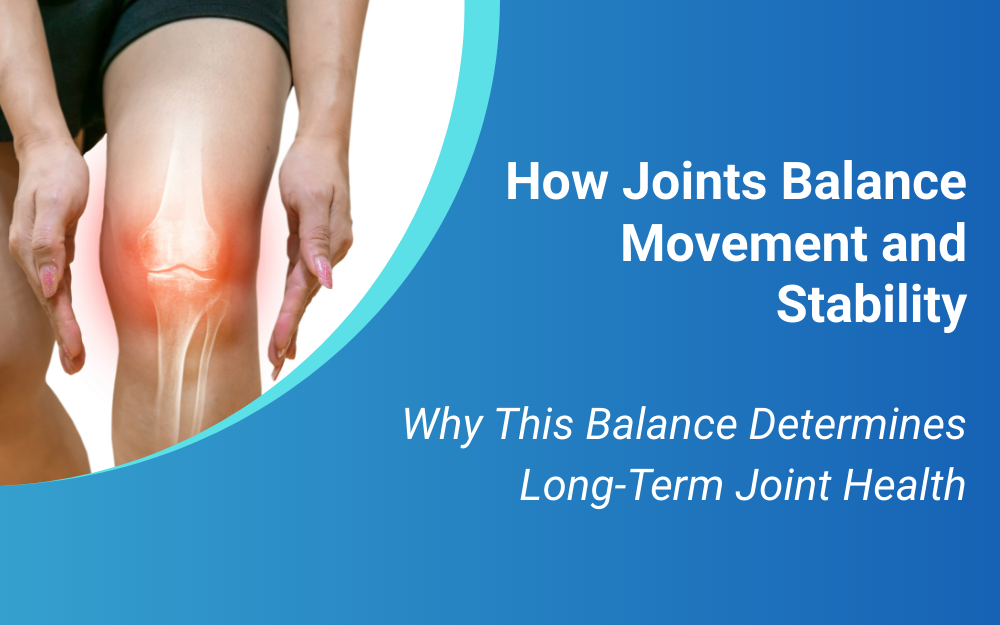
For many patients, joint pain doesn’t begin as severe pain. It begins as hesitation. A slight pause before stepping off a curb. A subtle fear of stairs. A feeling that the knee may “give way.” Or that the hip doesn’t move as freely as it once did.
What you’re experiencing is often not just pain; it’s a disruption in the delicate balance between movement and stability.
Healthy joints are designed to move smoothly while remaining structurally secure under load. When that balance shifts, symptoms follow. Understanding how joints balance mobility and stability explains why arthritis develops, why injuries occur, and why precision matters in modern joint replacement.
The Dual Role of Every Joint
Every major joint in the body, especially the hip and knee have two competing responsibilities:
- Provide mobility (flexion, extension, rotation)
- Maintain stability under body weight and dynamic forces
If a joint were built purely for mobility, it would dislocate easily. If it were built purely for stability, it would feel rigid and immobile. The body solves this through a layered support system.
What Creates Stability in a Joint?
True joint stability is not just “tight ligaments.” It is a coordinated system involving:
- Bone architecture – For example, the hip’s deep socket provides inherent containment.
- Articular cartilage – Allows even load distribution.
- Ligaments – Prevent excessive motion.
- Muscles and tendons – Provide dynamic, real-time control.
- Neuromuscular feedback – Corrects imbalance in milliseconds.
When you walk on flat ground, mobility dominates. When you stumble, stability instantly takes over. That seamless transition is what healthy joints do well.
When Balance Begins to Shift
In early osteoarthritis, cartilage gradually thins. As protective cushioning reduces:
- The load becomes uneven.
- Ligaments tighten to compensate.
- Muscles guard the joint.
- Alignment subtly changes.
Patients often describe paradoxical symptoms:
- “It feels stiff but unstable.”
- “My knee gives way.”
- “I don’t trust it on the stairs.”
- “Turning quickly causes pain.”
This is the joint struggling to maintain stability while losing smooth motion.
Weight-Bearing Forces Make Balance Critical
The hip and knee are weight-bearing joints. During stair climbing, forces may reach three to five times body weight. Even small alignment changes increase localised pressure. Over time, this accelerates cartilage wear and worsens instability. That is why precise alignment and load distribution are central principles in modern joint care.
How Joint Replacement Restores the Equation
When arthritis progresses to advanced stages, structural restoration may be required.
Modern hip and knee replacement aims to:
- Restore neutral or functional alignment
- Rebalance soft tissues
- Distribute load evenly across implant surfaces
- Recreate smooth articulation
But surgery restores structure and rehabilitation restores control.
The Recovery Timeline: Rebuilding Stability
Weeks 0–2: Establish Early Confidence
- Pain control and swelling management
- Assisted walking
- Gentle muscle activation
- Restoring full knee extension (for knee replacement)
Early movement stimulates circulation and neuromuscular reactivation.
Weeks 2–6: Regain Control
- Gait normalization
- Quadriceps and hip abductor strengthening
- Controlled stair practice
- Improving range of motion
This phase transitions the joint from a protected to a progressively loaded state.
Weeks 6–12: Restore Dynamic Stability
- Balance drills
- Step-down control
- Single-leg strength work
- Return to low-impact activity
By this stage, many patients report improved confidence compared to pre-surgery function.
What Patients Notice When Balance Is Restored
- Less “wobble fear”
- Smoother walking rhythm
- More predictable stairs
- Reduced swelling after activity
- Increased trust in the joint
Long-term implant durability depends not only on materials but also on balanced load sharing.
Risk Management: Why Precision Matters
If alignment is off by even a few degrees:
- The load may concentrate unevenly.
- Polyethylene wear may accelerate.
- Soft tissues may feel tight or unstable.
Modern surgical planning, including robotic assistance where appropriate, helps reduce variability and improve reproducibility.
The Quiet Truth About Great Joints
Healthy joints are not simply strong; they are coordinated. Movement without control leads to instability. Stability without mobility leads to stiffness. The goal is balance.
If joint pain has affected your stability, confidence, or daily function, schedule a consultation with Dr. Hulse to evaluate alignment, muscle balance, and structural integrity. A personalized plan, whether conservative care or surgical correction, can restore durable, confident movement grounded in precision and preparation.