
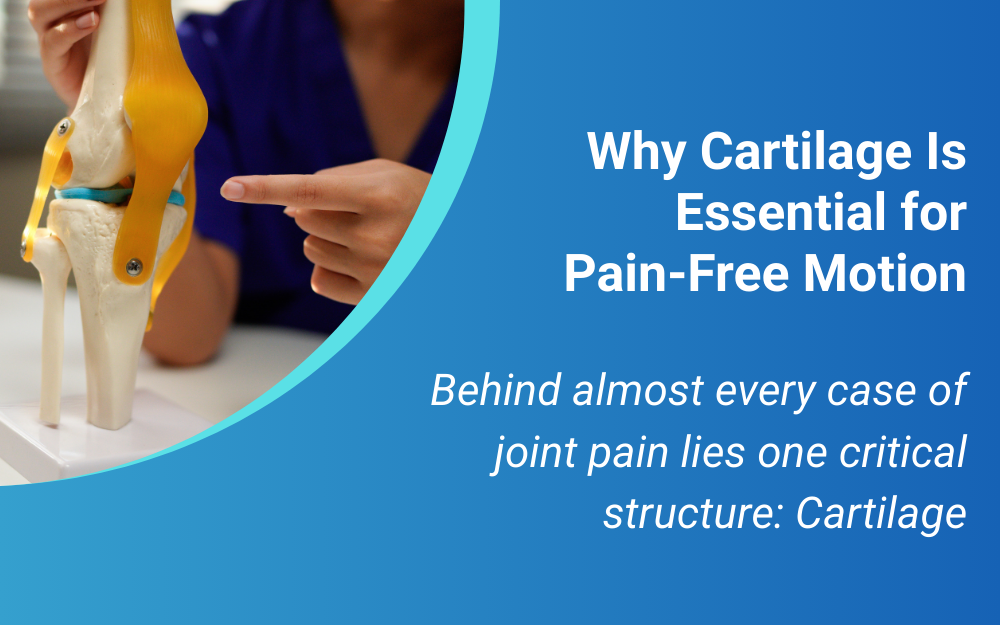
When patients describe early joint problems, they rarely mention cartilage.
They say:
“I hear grinding.”
“My knee feels stiff.”
“It hurts when I get up from a chair.”
But behind almost every case of joint pain lies one critical structure: Cartilage.
Cartilage is the silent protector inside your joints. It allows smooth, frictionless movement, absorbs shock, distributes weight, and protects the underlying bone. When cartilage is healthy, movement feels effortless. When it begins to wear down, even simple activities like climbing stairs or walking across a room can become uncomfortable.
Understanding why cartilage is essential for pain-free motion helps patients recognize problems early and make informed decisions before degeneration progresses.
What Exactly Is Cartilage?
Articular cartilage is a smooth, white, rubber-like tissue that covers the ends of bones where they meet in a joint.
It has four essential characteristics:
- It is smooth and low-friction
- It is highly elastic and shock-absorbing
- It distributes the load evenly
- It protects bone surfaces from direct contact
Unlike muscle or skin, cartilage contains no blood vessels, no nerves, and no direct blood supply. That design is efficient for movement, but it also explains why cartilage injuries behave differently from other tissues.
How Cartilage Creates Pain-Free Motion
A healthy joint functions like a perfectly engineered mechanical system.
-
Friction Reduction
Cartilage reduces friction to an extraordinary degree, even smoother than ice on ice. This allows bones to glide effortlessly during:
- Walking
- Squatting
- Bending
- Twisting
- Climbing stairs
Without cartilage, bone would rub directly against bone, producing pain and inflammation.
-
Shock Absorption
Every step you take generates a force equal to several times your body weight. Cartilage absorbs and distributes this load so that:
- Pressure is not concentrated in one area
- The joint surface remains protected
- Microtrauma does not accumulate quickly
In weight-bearing joints like the knee and hip, this function is essential for long-term durability.
-
Load Distribution
Cartilage spreads mechanical forces evenly across the joint surface.
When cartilage begins to thin:
- Pressure becomes uneven
- Certain areas overload
- Degeneration accelerates
This uneven stress is one reason arthritis progresses over time.
Why Cartilage Damage Causes Pain
Cartilage itself does not have nerves. So how does it cause pain? The pain arises when cartilage loss exposes the underlying bone. Bone contains nerve endings. When protective cartilage thins:
- Bone experiences increased pressure
- Inflammation develops
- Microfractures may occur
- The joint becomes stiff and swollen
This is the process that leads to osteoarthritis.
Early Warning Signs of Cartilage Wear
Cartilage damage often begins silently. Symptoms gradually appear as degeneration progresses:
- Morning stiffness lasting more than 15–20 minutes
- Grinding or cracking sounds (crepitus)
- Swelling after activity
- Pain during weight-bearing
- Reduced range of motion
What Causes Cartilage Breakdown?
Cartilage deterioration is rarely due to one single cause. It typically results from a combination of factors:
Age-Related Degeneration
Natural thinning over time.
Mechanical Malalignment
Bowlegs or knock knees cause uneven weight distribution.
Previous Injury
Meniscus tears or ligament injuries accelerate wear.
Obesity
Increased load speeds cartilage breakdown.
Repetitive Impact
High-impact sports without adequate recovery.
Understanding the cause helps guide the treatment strategy.
Can Cartilage Heal on Its Own?
This is one of the most common questions patients ask. Unfortunately, cartilage has very limited self-healing ability. Because it lacks a direct blood supply:
- Nutrients reach it through joint fluid diffusion
- Regeneration is slow
- Large defects do not repair naturally
Small injuries may stabilize, but significant damage usually progresses without treatment.
Treatment Options for Cartilage Preservation
When detected early, several strategies may slow progression:
Non-Surgical Options
- Weight optimization
- Strengthening surrounding muscles
- Activity modification
- Anti-inflammatory management
These approaches reduce stress on remaining cartilage.
Surgical Options (When Indicated)
- Cartilage repair procedures (in selected younger patients)
- Osteotomy for alignment correction
- Partial or total joint replacement in advanced degeneration
The goal is always to preserve natural joint function whenever possible.
Why Timing Matters
Cartilage loss follows a predictable pattern:
- Surface softening
- Thinning
- Fissuring
- Full-thickness loss
- Bone-on-bone contact
Intervening at Stage 1 or 2 is very different from treating Stage 5. Delaying evaluation can allow minor cartilage damage to become structural arthritis requiring joint replacement. Early assessment provides more options and often less invasive solutions.
What Patients Notice After Cartilage Is Restored or Replaced
When the damaged cartilage surface is corrected, either preserved or replaced, patients typically report:
- Smoother movement
- Reduced stiffness
- Improved confidence on stairs
- Less swelling
- Greater endurance during walking
The goal is not just pain relief but restoring functional motion.
The Long-Term Perspective
Cartilage health determines joint longevity.
Protecting cartilage means:
- Maintaining alignment
- Preserving muscle strength
- Avoiding repetitive overload
- Addressing injuries early
Pain-free motion is not accidental. It is structural.
When Should You Seek Evaluation?
- Pain persists beyond 6 weeks
- Stiffness interferes with daily activities
- Swelling is recurrent
- Imaging shows cartilage thinning
- Walking tolerance is decreasing
Early diagnosis allows for preservation strategies before irreversible damage occurs. Cartilage is essential for smooth, stable, pain-free movement. It cushions, protects, and enables the joint to function under tremendous mechanical demand. When cartilage begins to fail, the effects ripple across the entire joint system. The encouraging reality is this: early evaluation, proper mechanical assessment, and personalized treatment can dramatically slow progression and preserve function. Your joint pain may not just be “ageing.” It may be structural cartilage wear, and that deserves thoughtful evaluation.
If you are experiencing persistent joint pain, stiffness, or grinding sensations, schedule a consultation with Dr. Hulse for a detailed cartilage and alignment assessment. Restoring pain-free motion begins with understanding the health of your cartilage.