
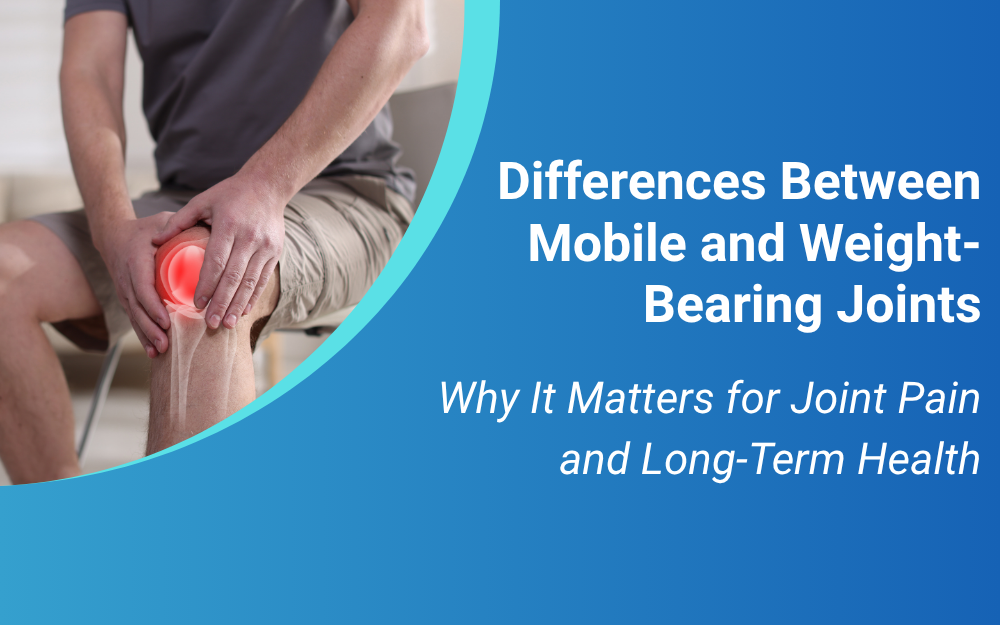
Not all joints in the body are built the same.
Some are designed for freedom and range of motion. Others are engineered for strength and load-bearing durability. Understanding the difference between mobile joints and weight-bearing joints helps explain why certain joints develop arthritis earlier, why hip and knee replacements are common, and why treatment strategies differ depending on the joint involved.
When patients understand joint mechanics, they make better decisions about prevention, recovery, and long-term joint preservation.
What Are Mobile Joints?
Mobile joints are designed primarily for movement. Their main purpose is to allow a wide range of motion in multiple directions.
Common examples include:
- Shoulder joint
- Wrist joint
- Elbow joint
- Ankle (partially weight-bearing but highly mobile)
These joints prioritize flexibility over stability.
Characteristics of Mobile Joints
Mobile joints typically have:
- A large range of motion
- Looser ligament structures
- Greater muscular dependence for stability
- Less constant load compared to the hips and knees
What Are Weight-Bearing Joints?
Weight-bearing joints are designed to support body weight during standing, walking, running, and climbing.
The primary weight-bearing joints include:
- Hip joint
- Knee joint
- Ankle joint
- Spine
Characteristics of Weight-Bearing Joints
Weight-bearing joints typically:
- Support several times body weight during activity
- Have thicker cartilage surfaces
- Depend heavily on alignment
- Experience repetitive compressive forces
- Are more prone to degenerative arthritis
For example, the knee can experience forces equal to three to five times body weight during stair climbing. That repetitive load over decades explains why knee arthritis is one of the most common orthopaedic conditions worldwide.
Key Structural Differences
1. Cartilage Thickness
Weight-bearing joints have thicker cartilage to absorb load.
Mobile joints, such as the shoulder, have thinner cartilage because they are not constantly under compression.
2. Stability Mechanism
Mobile joints rely heavily on muscles for stability.
Weight-bearing joints rely on bone structure, ligaments, and alignment.
If alignment is off in a weight-bearing joint, pressure becomes uneven, accelerating cartilage wear.
3. Injury Patterns
Mobile joints are more prone to:
- Dislocations
- Instability
- Soft tissue injuries
Weight-bearing joints are more prone to:
- Cartilage degeneration
- Meniscal tears
- Osteoarthritis
- Stress fractures
Understanding this difference helps guide both prevention and treatment.
Why Weight-Bearing Joints Develop Arthritis More Often
Arthritis develops when cartilage deteriorates under mechanical stress.
Weight-bearing joints are exposed to:
- Repetitive compression
- Long-term load accumulation
- Minor alignment variations over decades
- Age-related cartilage thinning
Even small malalignment in the knee can increase pressure on one compartment, accelerating cartilage loss. That is why knee and hip replacements are among the most common orthopaedic procedures globally.
Why Mobile Joints Fail Differently
Mobile joints, such as the shoulder, are less likely to develop severe arthritis early in life. Instead, they fail through:
- Recurrent instability
- Rotator cuff tears
- Labral injuries
- Impingement syndromes
When arthritis does develop in a mobile joint, it is often secondary to trauma or chronic instability.
Symptoms: How Patients Experience the Difference
Weight-Bearing Joint Pain
Patients often report:
- Pain during walking or standing
- Difficulty climbing stairs
- Pain that worsens with prolonged activity
- Stiffness after sitting
The pain is mechanical, which is triggered by load.
Mobile Joint Pain
Patients typically report:
- Pain with overhead movement
- Clicking or instability
- Weakness during lifting
- Night pain when lying on the affected side
The pain is movement-based rather than load-based.
Why This Distinction Matters in Treatment Planning
In Weight-Bearing Joints
The focus is on:
- Alignment correction
- Load distribution
- Muscle strengthening
- Cartilage preservation
- Joint replacement when degeneration is advanced
Precision in alignment during hip or knee replacement is critical because these joints must support body weight long-term.
In Mobile Joints
The focus is on:
- Stabilizing soft tissues
- Repairing tendons or ligaments
- Restoring muscular balance
- Preserving range of motion
Joint replacement in mobile joints, such as shoulder replacement, is typically considered later and for different reasons compared to hip or knee replacement.
Prevention Strategies Differ Too
For weight-bearing joints:
- Maintain a healthy body weight
- Correct malalignment early
- Strengthen quadriceps and hip stabilizers
- Avoid repetitive high-impact stress
For mobile joints:
- Maintain rotator cuff strength
- Avoid repetitive overhead strain
- Address instability early
Understanding the joint’s primary function guides long-term protection.
The Long-Term Perspective
Your joints are not interchangeable mechanical parts. Each is engineered for a specific balance of mobility and stability. When that balance is disrupted by injury, misalignment, or cartilage loss, symptoms appear. The shoulder is not built to bear body weight like the hip. Treatment must respect these differences.
When Should You Seek Evaluation?
Consider an orthopaedic evaluation if:
- Pain in a weight-bearing joint limits walking
- Instability in a mobile joint causes repeated episodes
- Swelling persists after activity
- Stiffness worsens over months
- Daily function is declining
Early intervention often prevents long-term structural damage. Mobile and weight-bearing joints serve fundamentally different roles in the body.
Weight-bearing joints prioritize strength and load support, making them vulnerable to degenerative arthritis.
Mobile joints prioritize flexibility and range, making them vulnerable to instability and soft tissue injuries.
Recognizing these differences allows for more accurate diagnosis, smarter prevention, and more personalized treatment. If hip, knee, shoulder, or ankle pain is affecting your mobility or stability, schedule a comprehensive joint evaluation with Dr. Hulse. A detailed mechanical assessment can identify whether load, alignment, instability, or cartilage degeneration is the primary issue and guide a personalized plan for long-term joint preservation or replacement if necessary.
Understanding your joints’ function is the first step toward restoring confident, pain-free movement.