
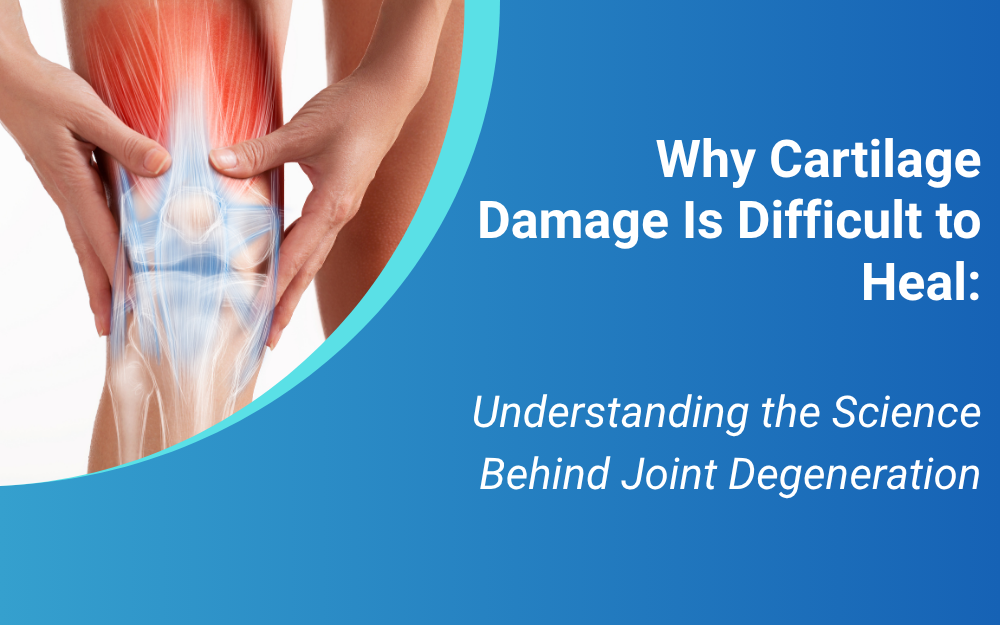
One of the most common and frustrating questions patients ask is:
“If cartilage is damaged, why can’t it just heal like a muscle or a bone?”
It is a reasonable question. After all, most tissues in the body repair themselves after injury. Cuts close. Fractures mend. Muscles rebuild. Cartilage does not.
Understanding why cartilage damage is difficult to heal is essential for anyone dealing with knee pain, hip arthritis, or joint degeneration. The answer lies in the unique biology of cartilage, which explains why early intervention is so important in preserving long-term joint function.
What Makes Cartilage Different from Other Tissues?
Articular cartilage is a smooth, rubber-like tissue that covers the ends of bones inside synovial joints.
Its design is remarkable:
- Extremely smooth surface
- Highly durable under compressive load
- Elastic yet firm
- Capable of distributing weight evenly
However, cartilage has one critical limitation:
It has no direct blood supply.
Unlike bone or muscle, cartilage does not contain:
- Blood vessels
- Nerves
- Lymphatic channels
This absence of vascular supply is the primary reason cartilage heals poorly.
Why Blood Supply Matters for Healing
Healing requires three essential components:
- Blood flow
- Inflammatory response
- Cellular regeneration
When you cut your skin, blood delivers:
- Oxygen
- Nutrients
- Repair cells
- Growth factors
Cartilage lacks this mechanism. Instead, it receives nutrients indirectly from synovial fluid through diffusion, a much slower and less efficient process.
As a result:
- Small injuries may stabilize
- Larger defects rarely regenerate naturally
- Progressive damage is common
The Limited Repair Capacity of Cartilage Cells
Cartilage is composed primarily of cells called Chondrocytes.
These cells:
- Maintain the cartilage matrix
- Produce collagen and proteoglycans
- Support shock absorption
However, chondrocytes have very low replication ability.
When cartilage is damaged:
- Few new cells are produced
- Matrix repair is minimal
- Structural integrity declines
In adults, regenerative potential is especially limited compared to that of children.
What Happens After Cartilage Injury?
Cartilage damage typically follows a predictable progression:
- Surface softening
- Fissures or cracks
- Partial-thickness loss
- Full-thickness defects
- Bone exposure (bone-on-bone arthritis)
Because cartilage does not heal effectively, even small defects can enlarge over time. Once the underlying bone becomes exposed, pain increases significantly.
Why Weight-Bearing Accelerates Damage
Cartilage injuries are particularly problematic in weight-bearing joints like the knee and hip. Every step places compressive force on the joint. When cartilage is intact, the load is distributed evenly.
When cartilage is damaged:
- Stress concentrates in smaller areas
- Mechanical overload increases
- Degeneration accelerates
Even minor alignment differences can worsen this cycle.
Why Rest Alone Is Not a Solution
Many patients assume that resting a painful joint will allow cartilage to heal.
Unfortunately:
- Cartilage requires movement to receive nutrients
- Complete inactivity weakens surrounding muscles
- Joint stiffness increases
- Load distribution worsens
Controlled, guided movement is beneficial, but structural defects will not regenerate solely with rest.
Can Cartilage Ever Repair Itself?
The answer depends on the depth of the injury.
Superficial Damage
Minor surface softening may stabilize with:
- Activity modification
- Strengthening programs
- Weight optimization
- Anti-inflammatory management
However, true regeneration is rare.
Deep Cartilage Defects
When damage reaches bone:
- The body may attempt to fill the area with fibrous tissue
- This tissue is not true cartilage
- It lacks durability and elasticity
- It breaks down more easily
Modern Treatment Options for Cartilage Damage
Because natural healing is limited, medical intervention focuses on:
Non-Surgical Strategies
- Strengthening supporting muscles
- Correcting biomechanical imbalances
- Anti-inflammatory therapies
- Viscosupplementation injections
- Weight reduction to decrease the load
These strategies aim to slow progression.
Surgical Cartilage Restoration
- Microfracture techniques
- Cartilage grafting
- Autologous chondrocyte implantation
These techniques aim to stimulate repair — but outcomes depend on the patient’s age, defect size, and joint alignment.
Joint Replacement in Advanced Damage
When cartilage loss becomes extensive:
- Bone-on-bone contact develops
- Pain becomes constant
- Function declines
At this stage, joint replacement may provide the most reliable long-term solution. Modern implants are engineered to recreate smooth articulation, effectively replacing damaged cartilage surfaces.
Why Early Diagnosis Changes Outcomes
Cartilage damage rarely begins suddenly.
Early warning signs include:
- Persistent stiffness
- Grinding sensations
- Swelling after activity
- Reduced walking tolerance
- Pain with weight-bearing
Imaging studies can detect cartilage thinning before complete loss.
The earlier damage is identified:
- The more conservative options are available
- The greater the opportunity for joint preservation
- The lower the likelihood of needing early replacement
The Long-Term Perspective on Joint Health
Cartilage damage is not simply an “ageing problem.”
It is often influenced by:
- Alignment abnormalities
- Previous injuries
- Muscle weakness
- Repetitive impact stress
- Obesity
Protecting cartilage requires a comprehensive approach to joint mechanics.
As emphasized in Dr Hulse’s Joint Replacements: A Patient’s Handbook, informed patients make better long-term decisions about joint preservation and surgical timing. Understanding the biological limits of cartilage healing prevents unrealistic expectations and promotes proactive care.
When Should You Seek Evaluation?
- Pain persists beyond several weeks
- Swelling recurs regularly
- Walking tolerance declines
- Imaging shows cartilage thinning
- Conservative treatments are no longer effective
Ignoring cartilage damage allows progression. Addressing it early preserves options. Unlike muscle or bone, cartilage cannot simply “repair itself.”That biological limitation makes early detection and mechanical correction essential. The goal is not just pain relief, but preserving joint structure for decades.
When cartilage health declines, thoughtful evaluation and timely intervention can slow degeneration and restore confident movement.
Schedule a detailed evaluation with Dr. Hulse, as early assessment can determine whether preservation strategies are appropriate or whether advanced treatment options are needed to protect long-term joint function.
Understanding cartilage biology today can help prevent irreversible joint damage tomorrow.