
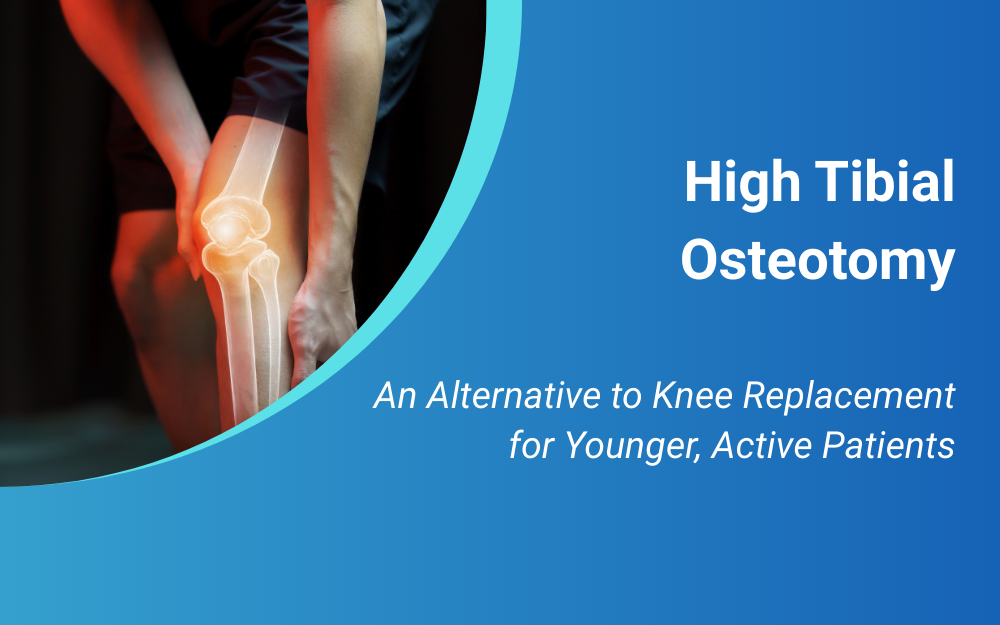
For many people in their 40s and 50s dealing with knee arthritis, the thought of a full knee replacement feels too soon. “I’m too young for this,” they think. “What happens when the implant wears out in 20 years?”
There’s another option that’s often overlooked: High Tibial Osteotomy (HTO).
This procedure doesn’t replace your knee—it realigns it. By shifting weight away from the damaged area, HTO can relieve pain, slow arthritis progression, and delay or even eliminate the need for knee replacement. For the right patient, it’s a game-changer that preserves the natural joint while buying valuable time.
As Dr. Narayan Hulse explains in his book Joint Replacements: A Patient’s Handbook, understanding all your options, including joint-preserving procedures, is essential to making the right decision for your unique situation.
What Is High Tibial Osteotomy?
High tibial osteotomy is a surgical procedure that reshapes the shin bone to correct alignment and redistribute weight across the knee joint.
In a healthy knee, weight is distributed evenly across both the inner and outer compartments. But when arthritis develops on one side—most commonly the inner side—the knee becomes bow-legged, placing even more pressure on the damaged cartilage.
HTO works by:
- Creating a controlled cut in the upper tibia
- Opening or closing a wedge to shift the knee angle
- Fixing the bone in the new position with a plate and screws
- Allowing the bone to heal over 8–12 weeks
The result: weight shifts to the healthier side of the knee, reducing pain and slowing cartilage breakdown.
Who Is the Ideal Candidate for HTO?
HTO isn’t for everyone. It works best for a specific patient profile:
Ideal Candidates:
- Age under 60 (typically 40–55)
- Active lifestyle with sports or physical work
- Arthritis isolated to one compartment (usually medial/inner)
- Stable ligaments (intact ACL and MCL)
- Good range of motion (at least 90° flexion)
- Healthy body weight (BMI under 30–32)
- Motivated to complete rehabilitation
Not Ideal For:
- Arthritis in multiple compartments
- Severe cartilage loss (bone-on-bone across the whole joint)
- Inflammatory arthritis (rheumatoid arthritis)
- Significant knee stiffness or instability
- Older patients with lower activity demands
The surgery essentially “buys time” before knee replacement becomes necessary, often 7–15 years or more.
Opening Wedge vs. Closing Wedge: What’s the Difference?
There are two main techniques for HTO:
Opening Wedge (More Common)
- A cut is made on the inner side of the tibia
- The bone is “opened” like a book
- A wedge-shaped spacer (bone graft or synthetic) is inserted
- Fixed with a plate and screws
- Allows precise correction
Closing Wedge
- A wedge of bone is removed from the outer tibia
- The gap is closed and fixed
- Less common today due to nerve risk and fibula complications
Most surgeons prefer the opening wedge technique for its precision and lower complication rate.
The Surgery: What to Expect
HTO is performed under general or spinal anesthesia and typically takes 60–90 minutes.
Recovery Timeline: What Patients Can Expect
HTO recovery requires patience and commitment—it’s longer than knee replacement.
- Week 1–2: Protected Weight-Bearing
- Week 3–6: Gradual Loading
- Week 6–12: Bone Healing Phase
- 3–6 Months: Return to Activity
- 6–12 Months: Full Recovery
Full recovery takes 9–12 months—significantly longer than knee replacement—but the payoff is preserving your natural knee.
Pain Relief: How Effective Is HTO?
Studies show that 80–90% of patients experience significant pain relief after HTO, with results lasting 7–15 years on average. Some patients go 20+ years before needing further intervention.
The key is patient selection. When performed on the right candidate, HTO can:
- Reduce pain by 70–80%
- Improve knee function and stability
- Allow return to sports and active work
- Delay knee replacement by a decade or more
Risks and Complications
Like any surgery, HTO carries risks:
- Delayed bone healing (especially in smokers)
- Under or over-correction requiring revision
- Infection
- Blood clots (similar to knee replacement)
- Nerve injury (rare, usually temporary)
- Hardware irritation requiring later removal (10–15% of cases)
Modern techniques and robotic planning are reducing these risks, but careful patient selection and surgeon experience remain critical.
HTO vs. Knee Replacement: Which Is Right for You?
Choose HTO if you:
- Are under 60 and highly active
- Have single-compartment arthritis
- Want to preserve your natural knee
- Are willing to commit to longer recovery
- Need to delay knee replacement
Choose Knee Replacement if you:
- Have multi-compartment arthritis
- Are over 60 with lower activity demands
- Want faster recovery and more predictable pain relief
- Have severe bone-on-bone arthritis
The choice isn’t always clear-cut. Dr. Hulse’s approach emphasizes individualized assessment—looking at X-rays, MRI findings, alignment, activity goals, and patient expectations.
Can You Still Get a Knee Replacement After HTO?
Yes. HTO doesn’t “burn bridges.”
If arthritis progresses years later, knee replacement remains an option. The plate and screws are removed, and the replacement proceeds as usual. Some studies even suggest that prior HTO may improve knee replacement outcomes by correcting alignment beforehand.
The Role of Robotics in HTO
Advanced planning tools and robotic systems are beginning to play a role in HTO by:
- Calculating the exact wedge angle needed
- Simulating the correction before surgery
- Guiding precise bone cuts
- Reducing the risk of under or over-correction
This level of precision helps optimize outcomes and reduce complications.
Lifestyle Modifications After HTO
To maximize the longevity of your osteotomy:
- Maintain a healthy body weight
- Avoid high-impact activities (running on hard surfaces, jumping sports)
- Focus on low-impact exercise (cycling, swimming, elliptical)
- Strengthen surrounding muscles (quadriceps, hamstrings, glutes)
- Follow up regularly with your surgeon
High tibial osteotomy isn’t a cure for arthritis—it’s a strategic delay. For younger, active patients with isolated knee arthritis, it offers years of pain relief while preserving the natural joint and keeping future options open.
It demands more from patients than knee replacement—longer recovery, more rehab, more patience—but for the right candidate, the reward is worth it: a natural knee that functions well for another decade or more.
Ready to explore whether HTO is right for your knee? Schedule a consultation with Dr. Hulse to review your X-rays, discuss your activity goals, and determine the best path forward.