
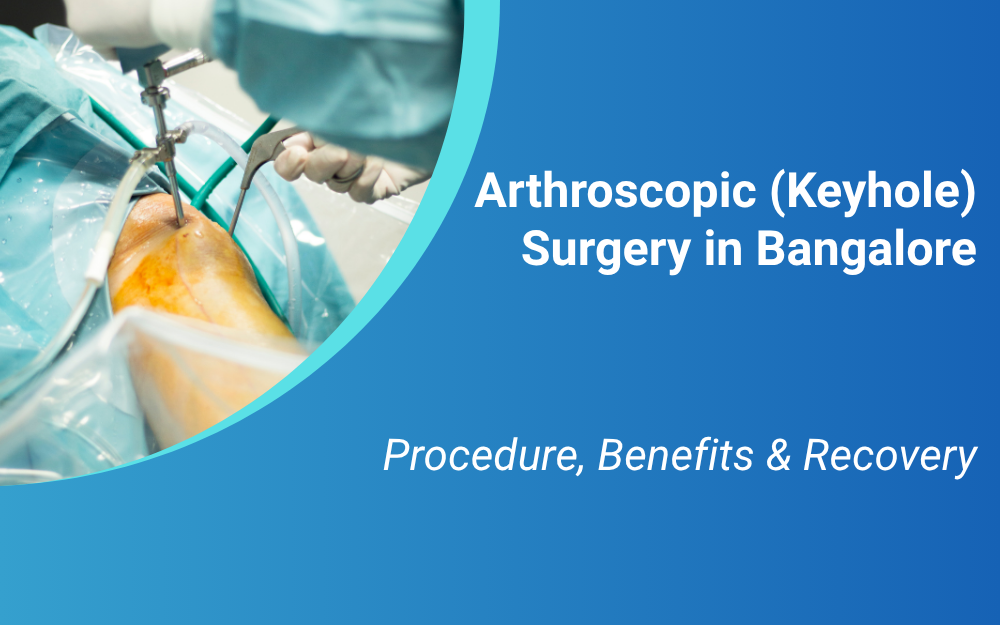
Arthroscopic (Keyhole) Surgery in Bangalore is a minimally invasive orthopedic procedure used to diagnose and treat joint problems using small incisions and a tiny camera called an arthroscope. It is commonly performed for ACL tears, meniscus injuries, shoulder problems, and sports injuries, offering faster recovery, smaller scars, and reduced tissue damage compared to traditional open surgery.
What Is Arthroscopic (Keyhole) Surgery?
Arthroscopic surgery, also known as keyhole surgery, is a minimally invasive orthopedic procedure used to examine and treat problems inside a joint.
During the procedure:
- Small incisions are created around the joint
- A tiny camera called an arthroscope is inserted
- Specialized instruments are used for treatment
- The surgeon views the joint on a monitor in real time
Arthroscopy is commonly used for knee, shoulder, ankle, and ligament injuries.
Why Is Arthroscopic Surgery Popular in Orthopedics?
Arthroscopic surgery has become widely preferred because it allows surgeons to treat joint problems with minimal tissue disruption.
Benefits of arthroscopic surgery include:
- Smaller incisions
- Less post-operative pain
- Faster recovery
- Reduced blood loss
- Shorter hospital stay
- Smaller scars
- Faster rehabilitation
- Earlier return to daily activities
Many sports injury treatments are now performed arthroscopically.
Which Conditions Can Be Treated With Arthroscopic Surgery?
Arthroscopic surgery is commonly used for both diagnosis and treatment of orthopedic conditions.
Common conditions treated include:
- ACL tears
- Meniscus injuries
- Shoulder instability
- Rotator cuff injuries
- Cartilage damage
- Loose joint fragments
- Sports injuries
- Knee swelling and locking
The procedure helps improve joint movement, stability, and pain relief.
How Is Arthroscopic (Keyhole) Surgery Performed?
Arthroscopic surgery is usually performed under anesthesia using minimally invasive techniques.
The procedure typically involves:
- Creating small keyhole incisions
- Inserting the arthroscope into the joint
- Examining damaged tissues
- Repairing or removing injured structures
- Cleaning the joint if necessary
- Closing the small incisions
Most procedures are completed within 1–2 hours depending on the complexity of the injury.
What Happens After Arthroscopic Surgery?
Recovery after arthroscopic surgery depends on the joint involved, injury severity, and rehabilitation plan.
Patients may experience:
- Mild swelling
- Temporary stiffness
- Mild discomfort
- Gradual improvement in movement
- Better joint stability over time
Many patients begin walking or joint movement within a few days after surgery.
What Is the Recovery Timeline After Arthroscopic Surgery?
| Recovery Stage | Timeline | Recovery Goal |
| Immediate Recovery | First 1–2 weeks | Reduce pain and swelling |
| Early Rehabilitation | Week 2–6 | Restore movement |
| Strengthening Phase | Month 2–3 | Improve muscle strength |
| Functional Recovery | Month 3–4 | Improve balance and coordination |
| Advanced Rehabilitation | Month 4–6 | Return to active lifestyle |
| Sports Recovery | Month 6+ | Return to sports safely |
Recovery speed varies depending on rehabilitation consistency and the type of arthroscopic procedure performed.
Which Exercises Are Recommended After Arthroscopic Surgery?
Rehabilitation exercises help restore movement and reduce stiffness after surgery.
Common post-arthroscopy exercises include:
- Heel slides
- Quad strengthening
- Straight leg raises
- Stationary cycling
- Balance exercises
- Hamstring strengthening
- Controlled mobility drills
Physiotherapy plays an important role in restoring long-term joint function.
What Are the Benefits of Arthroscopic Surgery Compared to Open Surgery?
| Feature | Arthroscopic Surgery | Traditional Open Surgery |
| Incision Size | Small keyhole incisions | Larger cuts |
| Tissue Damage | Minimal | More extensive |
| Scar Size | Smaller scars | Larger scars |
| Recovery Speed | Faster | Slower |
| Hospital Stay | Usually shorter | Often longer |
| Post-op Pain | Usually less discomfort | More pain possible |
Because of these advantages, arthroscopy is commonly preferred for sports injuries and ligament repairs.
Is Arthroscopic Surgery Painful?
Most patients experience mild to moderate discomfort during the initial recovery phase. Pain is usually managed with medications, ice therapy, and physiotherapy.
Compared to traditional open surgery, arthroscopic procedures often result in:
- Less tissue trauma
- Faster mobility
- Reduced swelling
- Shorter recovery period
Pain levels generally improve gradually over the first few weeks.
How Long Does Recovery Take After Arthroscopic Surgery?
Recovery timelines vary depending on the type of surgery and rehabilitation progress.
Approximate recovery timelines:
- Basic daily activities: 2–6 weeks
- Strength recovery: 2–4 months
- Running or sports drills: 4–6 months
- Competitive sports return: 6–9 months
Sports injury rehabilitation may require longer recovery for athletes.
Which Activities Should Be Avoided After Arthroscopic Surgery?
Some activities may delay healing or stress the recovering joint.
| Activity to Avoid | Why It Should Be Avoided | Safer Alternative |
| Running too early | Increased joint stress | Stationary cycling |
| Jump training | High impact on joint | Controlled strengthening |
| Heavy gym lifting | Delays tissue healing | Gradual resistance training |
| Twisting movements | Risk of re-injury | Straight-line walking |
| Sports without rehab | Increases instability | Guided physiotherapy |
| Ignoring swelling | Delays recovery | Ice and elevation |
Following rehabilitation instructions carefully helps improve long-term outcomes.
When Should You Consider Arthroscopic Surgery?
Arthroscopic surgery may be recommended when patients have:
- Persistent knee or shoulder pain
- Ligament tears
- Sports injuries
- Meniscus damage
- Joint instability
- Locking or catching sensations
- Failed non-surgical treatment
An orthopedic consultation helps determine whether arthroscopy is appropriate.
Why Is Physiotherapy Important After Arthroscopic Surgery?
Physiotherapy is essential after arthroscopy because it helps:
- Restore mobility
- Improve muscle strength
- Reduce stiffness
- Improve balance
- Prevent re-injury
- Restore joint confidence
Structured rehabilitation often improves long-term surgical outcomes significantly.
Conclusion
Arthroscopic (Keyhole) Surgery has transformed the way many orthopedic conditions are treated by allowing surgeons to diagnose and repair joint problems through minimally invasive techniques. With smaller incisions, reduced tissue damage, faster recovery, and improved rehabilitation outcomes, arthroscopy has become a preferred treatment option for many sports injuries, ligament tears, and joint disorders.
If you are experiencing persistent knee pain, shoulder instability, sports injuries, or joint-related problems, an orthopedic evaluation can help determine whether arthroscopic surgery is the right treatment option for you.
About Dr. Narayan Hulse
Dr. Narayan Hulse is a leading Orthopaedic and Joint Replacement Surgeon with 7,000+ successful joint replacement surgeries to his credit. He specialises in arthroscopic surgery, sports injury treatment, robotic joint replacement, and advanced orthopedic care.
He is also the author of “Joint Replacements: A Patient’s HandBook” a valuable resource designed to help patients better understand joint replacement surgery, recovery, and rehabilitation.
Frequently Asked Questions About Arthroscopic (Keyhole) Surgery
What is arthroscopic (keyhole) surgery?
Arthroscopic surgery is a minimally invasive orthopedic procedure performed using small incisions and a tiny camera called an arthroscope. It allows surgeons to diagnose and treat joint injuries such as ACL tears, meniscus injuries, cartilage damage, and shoulder problems with less tissue damage compared to traditional open surgery.
Is arthroscopic surgery safer than open surgery?
Arthroscopic surgery is commonly associated with smaller scars, less tissue trauma, faster recovery, and reduced post-operative discomfort compared to open procedures. However, the appropriate surgical technique depends on the patient’s condition, injury type, and orthopedic evaluation.
How long does recovery take after arthroscopic surgery?
Recovery varies depending on the joint involved and the complexity of surgery. Many patients resume basic activities within a few weeks, while complete sports rehabilitation may take several months. Structured physiotherapy is important for restoring movement and long-term joint stability.
Can I walk after arthroscopic knee surgery?
Many patients begin assisted walking within a few days after arthroscopic knee surgery depending on the procedure performed. Walking progression is usually gradual and guided by pain levels, swelling, muscle strength, and rehabilitation progress.
Is physiotherapy necessary after arthroscopic surgery?
Yes. Physiotherapy helps restore strength, mobility, balance, and flexibility after arthroscopy. A structured rehabilitation program also reduces stiffness and lowers the risk of future joint problems or repeat injuries.
Which joints are commonly treated using arthroscopy?
Arthroscopy is commonly used for knee, shoulder, ankle, elbow, and hip joint problems. It is especially effective for sports injuries, ligament tears, cartilage damage, meniscus injuries, and shoulder instability.
Are arthroscopic surgery scars permanent?
Arthroscopic surgery usually leaves very small scars because the procedure uses tiny incisions. In many patients, scars fade significantly over time and are less noticeable compared to scars from traditional open surgery.