
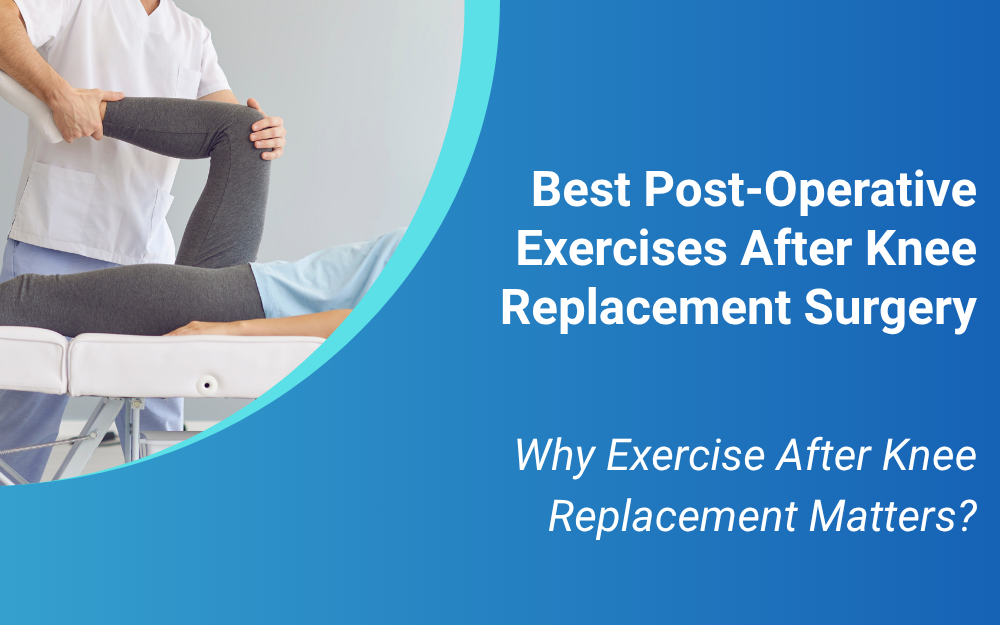
The best post-operative exercises after knee replacement surgery include ankle pumps, quadriceps sets, straight leg raises, heel slides, and knee bends. These exercises help reduce stiffness, improve blood circulation, strengthen muscles, and restore knee movement. Most patients begin gentle exercises within 24 hours of surgery under physiotherapy guidance.
At Dr. Narayan Hulse’s Clinic, patients consistently achieve faster recovery because they follow a structured exercise protocol from day one. Here are the best post-operative exercises after knee replacement surgery, broken down by recovery phase.
Key Takeaways
- Exercise begins within 24 hours of surgery
- Early movement prevents stiffness and blood clots
- Most patients walk independently within 3–6 weeks
- Consistency matters more than intensity
- Always follow your surgeon’s specific instructions
Why Exercise After Knee Replacement Matters
Many patients are surprised to learn that physiotherapy begins the very next day after surgery. This is intentional. Early movement:
- Reduces swelling and stiffness
- Prevents dangerous blood clots (DVT)
- Strengthens the muscles around the new joint
- Restores range of motion faster
Skipping or delaying exercises is the single biggest reason for slow recovery.
Phase 1: Days 1–7 (Hospital & Early Home)
These exercises are gentle and done while lying in bed or sitting on the edge.
Ankle Pumps- Move your foot up and down repeatedly, like pressing a car pedal. Do this 10–15 times every hour. This pumps blood back from your legs and prevents clots — the most important exercise in the first 48 hours.
Quad Sets- Lie flat. Tighten the muscle on top of your thigh by pressing the back of your knee into the bed. Hold for 5 seconds, release. Repeat 10 times. This “wakes up” the quadriceps muscle which goes weak after surgery.
Straight Leg Raises- Keep your operated leg straight and raise it about 12 inches off the bed. Hold for 3 seconds, lower slowly. Do 10 repetitions. This builds strength without bending the joint.
Heel Slides– Lying flat, slowly bend your knee by sliding your heel toward your buttocks as far as comfortable. Hold briefly, then slide back. Aim for more range each day.
Phase 2: Weeks 2–6 (Building Strength)
By week 2, most patients are moving with a walker. These exercises now focus on stability and increasing knee bend.
Standing Knee Bends Hold a sturdy support, slowly bend your operated knee back as far as comfortable. Hold 5 seconds, straighten. This is critical for regaining full range of motion.
Short Arc Quads Place a rolled towel under your knee. Straighten your leg fully, hold 5 seconds, lower. Repeat 15 times. Excellent for rebuilding quad strength safely.
Seated Knee Flexion Sit on a chair. Use your other foot to gently push the operated foot backward, increasing the bend. Hold 10 seconds. This improves flexibility progressively.
Mini Squats Hold a railing or countertop. Bend both knees slightly (only 20–30 degrees). Hold 5 seconds, stand straight. This trains balance and joint stability.
Phase 3: Weeks 6–12 (Return to Normal Life)
At this stage, most patients have stopped using walking aids. Exercises now focus on building confidence and endurance.
Stair Climbing Lead with the good leg going up, operated leg going down. Start with one step at a time, holding the railing. This is an excellent functional exercise.
Stationary Cycling Set the seat high so your knee bends only slightly. Pedal gently for 10–15 minutes. Cycling is one of the best low-impact exercises for knee replacement recovery.
Walking Programme Start with 5–10 minutes, increase by 5 minutes every few days. Walk on flat, even surfaces. Swimming is also excellent once the wound is fully healed.
What to Avoid
- High-impact activities like running or jumping (for at least 6 months)
- Kneeling directly on the operated knee
- Sitting with the knee bent for long periods in the early weeks
- Twisting movements
When to Call Your Doctor
Stop exercising and contact Dr. Hulse’s team if you notice sudden increase in pain, significant swelling, redness, or warmth around the knee, or a fever above 101°F.
Conclusion
Recovery after knee replacement is a journey and exercises are your most powerful tool. Patients who follow a consistent exercise programme under guidance recover faster, experience less pain, and achieve better long-term outcomes.
For a deeper understanding of your surgery and what to expect, read Dr. Narayan Hulse’s, Joint Replacements: A Patient’s Handbook — a complete guide designed to help you through every stage of your recovery.
Have questions about your recovery? Book a consultation with Dr. Narayan Hulse at Fortis Hospital, Bangalore.
Frequently Asked Questions
Q1. When can I start exercising after knee replacement surgery?
You can begin gentle exercises like ankle pumps and quad sets within 24 hours of surgery, while still in the hospital. Early movement is not just safe, it is strongly recommended by surgeons to prevent blood clots, reduce swelling, and speed up recovery. Your physiotherapist will guide you from day one.
Q2. How long does it take to walk normally after knee replacement?
Most patients walk with a walker within 1–2 days of surgery. By weeks 3–6, many patients walk independently without support. Full confidence walking on flat surfaces is typically achieved by 6–8 weeks. However, recovery varies depending on age, fitness level, and how consistently you follow your exercise programme.
Q3. Is it normal to feel pain while doing exercises after knee replacement?
Mild discomfort during exercises is normal and expected especially in the first 2–3 weeks. However, sharp or sudden pain is a signal to stop and inform your surgeon. A good rule of thumb: pain that settles within 30 minutes of finishing exercise is acceptable; pain that lingers longer means you may be overdoing it.
Q4. Which exercises should I absolutely avoid after knee replacement surgery?
Avoid high-impact activities like running, jumping, and contact sports for at least 6 months after surgery. Also avoid kneeling directly on the operated knee, deep squats beyond 90 degrees, and any twisting movements at the knee. Stationary cycling, swimming, and walking are the safest and most recommended activities during recovery.
Q5. How many times a day should I do physiotherapy exercises after knee replacement?
In the first 2 weeks, aim to do your exercises 2–3 times per day, with each session lasting 15–20 minutes. Shorter, more frequent sessions are more effective than one long session. As you progress to weeks 4–6, your physiotherapist may shift you to once daily with longer walks added in between.