
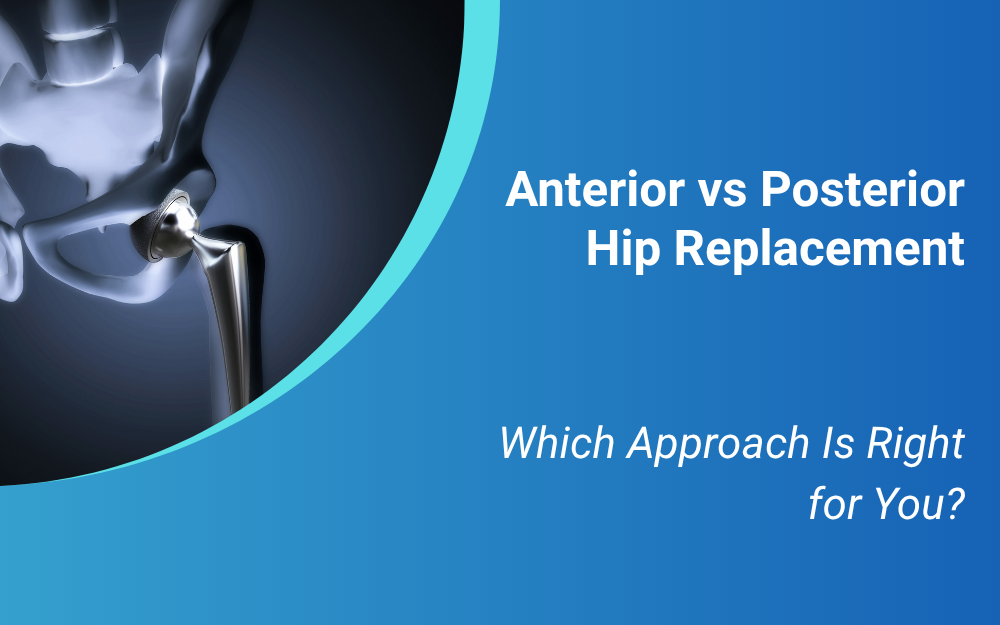
Anterior vs posterior hip replacement differs mainly in the surgical approach used to access the hip joint. The anterior approach enters from the front and may allow faster early recovery, while the posterior approach enters from the back and is often preferred for complex cases. Both approaches provide excellent long-term outcomes when performed by an experienced surgeon.
What Is Hip Replacement Surgery?
Hip replacement surgery, or total hip arthroplasty, involves removing the damaged ball and socket of the hip joint and replacing them with artificial implants. The goal is to eliminate pain, restore movement, and allow you to return to an active life.
The surgery itself is largely the same regardless of approach — what differs is the direction from which the surgeon accesses the hip joint, and which muscles and tissues are moved or cut in the process.
What Is the Anterior Approach?
In the anterior approach, the surgeon accesses the hip joint from the front of the body. The key advantage of this technique is that it works between the natural muscle intervals — meaning no muscles are cut or detached to reach the joint.
This muscle-sparing nature is the main reason the anterior approach has gained popularity in recent years. Because the muscles remain intact, many patients experience less post-operative pain, faster early recovery, and fewer movement restrictions in the initial weeks after surgery.
The anterior approach also allows the surgeon to use intraoperative X-ray guidance, which helps confirm precise implant positioning during the procedure itself.
What Is the Posterior Approach?
The posterior approach accesses the hip from the back. It is the most widely performed hip replacement technique in the world and has decades of proven, excellent outcomes behind it.
In this approach, some of the short external rotator muscles at the back of the hip are temporarily detached to access the joint and are carefully repaired at the end of the procedure. Historically, this led to a slightly higher dislocation risk in the early recovery period — however, with modern implants, advanced surgical techniques, and careful repair of the posterior capsule, this risk has reduced significantly.
The posterior approach offers excellent visibility of the joint, is technically versatile, and is well suited for complex cases including revision surgery, patients with significant deformity, or those who are obese.
Anterior vs Posterior Hip Replacement: Key Differences
Recovery Speed The anterior approach generally offers a faster early recovery. Patients tend to experience less pain in the first few weeks and may progress to independent walking sooner. However, by three to six months, outcomes between the two approaches are largely comparable.
Movement Restrictions With the anterior approach, patients typically have fewer movement precautions in the early weeks — there is generally no need to avoid crossing the legs or bending forward past 90 degrees, which is a common restriction after the posterior approach.
Surgical Complexity The posterior approach is more forgiving technically and offers better exposure for complex or revision cases. The anterior approach has a steeper learning curve and requires specialised training and equipment.
Scar Position The anterior approach leaves a scar on the front or side of the thigh, while the posterior approach leaves a scar on the outer back of the hip. For most patients this is a minor consideration, but worth knowing.
Dislocation Risk Historically the posterior approach carried a slightly higher dislocation risk, but with modern surgical techniques this difference is minimal. Both approaches, when performed by an experienced surgeon, carry very low dislocation rates.
Suitability The anterior approach may not be suitable for all patients — particularly those who are significantly overweight, very muscular, or have complex hip anatomy. The posterior approach is more universally applicable.
Which Approach Is Right for You?
This is the most commonly asked question — and the honest answer is that it depends on several factors: the patient’s body type, the condition of the hip, any previous surgeries, and crucially, the surgeon’s experience and training.
Both approaches, when performed correctly by a skilled and experienced surgeon, deliver excellent long-term results. The difference in outcomes at one year is small. What matters far more than the approach is the precision of implant placement, the quality of the implant used, and the commitment to post-operative physiotherapy.
Dr. Narayan Hulse discusses both options with every patient and makes the recommendation based on what gives that individual the best chance of a smooth, safe, and successful outcome not based on what is trending.
What About Robotic Hip Replacement?
At Fortis Hospital Bangalore, robotic-assisted hip replacement is performed using both anterior and posterior approaches. Robotic technology allows for real-time, patient-specific planning and precise implant positioning regardless of which approach is used resulting in better alignment, reduced implant wear, and improved long-term durability.
Conclusion
Both the anterior and posterior approaches to hip replacement are safe, effective, and well-established techniques. The anterior approach offers some advantages in early recovery, while the posterior approach offers greater versatility and a longer track record. The right choice depends on your individual anatomy, your surgeon’s expertise, and the complexity of your case.
The most important decision is not which approach — it is choosing a surgeon with the experience, skill, and honesty to guide you through that choice.
For a complete guide to hip replacement surgery and what to expect before, during, and after your procedure, read Dr. Narayan Hulse’s, Joint Replacements: A Patient’s Handbook — written specifically to help patients make informed decisions.
Book a consultation with Dr. Narayan Hulse at Fortis Hospital, Bangalore — and get a clear, personalised recommendation based on your specific condition.
📞 +91 94802 60001 | 🌐 drhulse.com
Frequently Asked Questions
Q1. What is the main difference between anterior and posterior hip replacement?
The main difference is the direction from which the surgeon accesses the hip joint. The anterior approach enters from the front without cutting muscles, while the posterior approach enters from the back with temporary detachment of some muscles. Both achieve the same goal — a successful hip replacement — but differ in early recovery experience and surgical technique.
Q2. Is the anterior approach always better than the posterior approach?
Not necessarily. The anterior approach offers faster early recovery for suitable patients, but the posterior approach has decades of proven outcomes and is better suited for complex cases, revision surgery, and patients with larger body types. The best approach depends on your individual anatomy and your surgeon’s expertise.
Q3. How long is recovery after anterior hip replacement compared to posterior?
Anterior hip replacement patients often experience faster early recovery — walking independently sooner and with fewer movement restrictions. However, by three to six months, recovery outcomes between both approaches are largely comparable. Long-term results are excellent with both techniques.
Q4. Are there movement restrictions after hip replacement?
After the posterior approach, patients are typically advised to avoid crossing their legs, bending forward past 90 degrees, and certain rotational movements in the early weeks. The anterior approach generally involves fewer such restrictions. Your surgeon will give you specific precautions based on your procedure.
Q5. What is robotic hip replacement and does it matter which approach is used?
Robotic hip replacement uses a robotic arm and real-time data to position implants with exceptional precision. At Fortis Hospital Bangalore, Mako robotic hip replacement is performed using both anterior and posterior approaches — the technology enhances accuracy regardless of which approach is chosen.
Q6. How do I know which hip replacement approach is right for me?
The right approach depends on your body type, hip anatomy, any previous surgeries, and your surgeon’s training and experience. Both approaches deliver excellent results when performed by a skilled surgeon. A thorough clinical evaluation and honest discussion with your orthopaedic surgeon is the best way to decide