
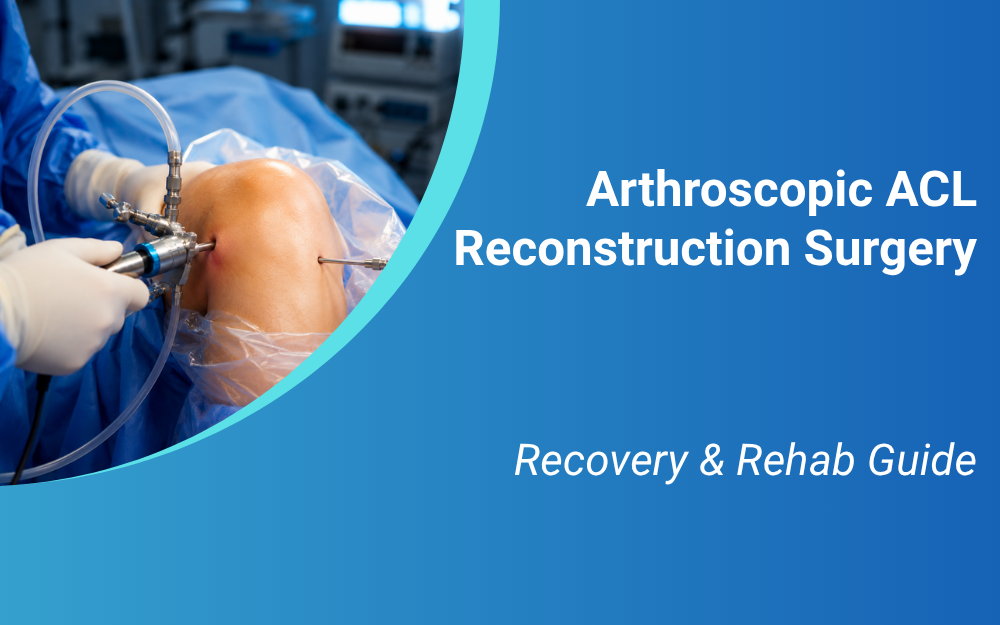
Arthroscopic ACL reconstruction surgery is a minimally invasive procedure used to repair a torn anterior cruciate ligament (ACL) in the knee. Recovery usually takes 6–9 months and involves structured physiotherapy, strength training, balance exercises, and gradual return-to-sports rehabilitation to restore knee stability and movement safely.
What Is Arthroscopic ACL Reconstruction Surgery?
Arthroscopic ACL reconstruction surgery is a keyhole procedure performed to replace a torn ACL using a graft taken from the patient’s own tendon or donor tissue.
The surgery is performed using:
- Small incisions
- A tiny camera called an arthroscope
- Specialized surgical instruments
Because the procedure is minimally invasive, patients often experience:
- Smaller scars
- Less tissue damage
- Faster rehabilitation
- Reduced post-operative discomfort
ACL reconstruction is commonly recommended for active individuals experiencing knee instability after ligament injury.
Why Is the ACL Important for Knee Stability?
The anterior cruciate ligament (ACL) is one of the main stabilizing ligaments of the knee.
It helps control:
- Knee rotation
- Sudden direction changes
- Jumping movements
- Forward knee movement
- Athletic stability
When the ACL tears, patients may experience knee buckling, instability, swelling, and difficulty returning to sports or physical activities.
What Are the Common Symptoms of an ACL Tear?
Common ACL injury symptoms include:
- Sudden popping sensation in the knee
- Immediate swelling
- Knee instability while walking
- Difficulty pivoting or turning
- Pain during movement
- Reduced range of motion
- Feeling that the knee may “give way”
Many sports injuries involving twisting movements can lead to ACL tears.
When Is Arthroscopic ACL Reconstruction Surgery Needed?
Not all ACL injuries require surgery. However, arthroscopic ACL reconstruction is commonly recommended when patients experience persistent instability or want to return to sports safely.
Surgery may be advised for:
- Complete ACL tears
- Athletes and active individuals
- Recurrent knee buckling
- Associated meniscus injuries
- Failed conservative treatment
- Knee instability affecting daily life
Early orthopedic evaluation helps determine the best treatment plan.
How Is Arthroscopic ACL Reconstruction Surgery Performed?
The procedure is usually performed under anesthesia using arthroscopic techniques.
Main steps include:
- Small incisions are created around the knee
- An arthroscope is inserted into the joint
- Torn ACL tissue is removed
- A graft is prepared
- Bone tunnels are created
- The new ligament graft is fixed into position
The surgery usually takes 1–2 hours depending on associated injuries.
What Is the Recovery Timeline After Arthroscopic ACL Reconstruction Surgery?
| Recovery Phase | Timeline | Main Goal |
| Early Recovery | Week 1–2 | Reduce swelling and pain |
| Mobility Phase | Week 2–6 | Restore knee movement |
| Strengthening Phase | Week 6–12 | Improve muscle strength |
| Balance Training | Month 3–4 | Restore coordination |
| Functional Recovery | Month 4–6 | Prepare for sports activity |
| Return-to-Sports Phase | Month 6–9 | Safe athletic rehabilitation |
Recovery varies depending on rehabilitation consistency, muscle strength, and healing progress.
What Happens During ACL Rehabilitation?
ACL rehabilitation is one of the most important parts of successful recovery after surgery.
Rehabilitation focuses on:
- Swelling control
- Restoring knee extension
- Strengthening quadriceps muscles
- Improving balance
- Restoring walking pattern
- Sports-specific training
A structured physiotherapy protocol helps reduce re-injury risk and improves long-term knee stability.
Which Exercises Are Common After ACL Reconstruction Surgery?
Early Rehabilitation Exercises
These exercises help improve mobility and muscle activation.
Common exercises include:
- Heel slides
- Quad sets
- Straight leg raises
- Ankle pumps
- Assisted knee bending
Intermediate Strengthening Exercises
As recovery progresses, strengthening exercises become more advanced.
Examples include:
- Mini squats
- Stationary cycling
- Step-ups
- Hamstring strengthening
- Resistance band training
Advanced Sports Rehabilitation Exercises
These exercises prepare patients for athletic movement and return-to-sports training.
Advanced rehabilitation may include:
- Agility drills
- Balance exercises
- Controlled jumping
- Running progression
- Single-leg strengthening
- Direction-change training
These activities should only begin after orthopedic clearance.
What Activities Should You Avoid After ACL Surgery?
Certain movements can stress the healing graft during recovery.
| Activity to Avoid | Why It Can Be Harmful | Safer Alternative |
| Running too early | Increased graft stress | Stationary cycling |
| Pivoting sports | Risk of re-injury | Straight-line walking |
| Deep squats | Excessive knee pressure | Partial squats |
| Jump training | High ligament impact | Balance drills |
| Sudden twisting | Causes instability | Controlled strengthening |
| Heavy gym training | Delays healing | Progressive rehab exercises |
Following the rehabilitation timeline carefully is essential for proper graft healing.
How Long Does It Take to Walk Normally After ACL Surgery?
Most patients begin assisted walking within a few days after surgery.
Walking improves gradually over time:
- Basic walking: 2–6 weeks
- Improved mobility: 2–3 months
- Running progression: 3–5 months
- Return to sports: 6–9 months
Patients recovering faster still require structured rehabilitation before returning to high-impact activity.
What Are the Risks of Delayed ACL Treatment?
Untreated ACL injuries may increase the risk of:
- Meniscus tears
- Cartilage damage
- Chronic knee instability
- Early arthritis
- Recurrent sports injuries
- Reduced athletic performance
Early diagnosis and treatment planning help protect long-term knee health.
Arthroscopic ACL Reconstruction Surgery vs Open ACL Surgery
| Feature | Arthroscopic ACL Reconstruction | Open ACL Surgery |
| Incision Size | Small keyhole incisions | Larger incisions |
| Tissue Damage | Minimal | More extensive |
| Recovery Speed | Faster rehabilitation | Slower recovery |
| Post-op Pain | Usually less | Often more discomfort |
| Scar Appearance | Smaller scars | Larger scars |
| Hospital Stay | Usually shorter | May be longer |
Arthroscopic techniques are now commonly preferred because of their minimally invasive approach.
When Should You See an Orthopedic Specialist?
You should consult an orthopedic specialist if you experience:
- Knee instability after sports injury
- Persistent swelling
- Difficulty turning or pivoting
- Repeated knee buckling
- Inability to return to sports
- Pain while climbing stairs
- Reduced knee movement
Early evaluation helps prevent further joint damage.
Conclusion
With the right surgical technique and rehabilitation approach, patients recovering from ACL injuries can restore knee stability, improve strength, and safely return to active lifestyles.
Arthroscopic ACL Reconstruction Surgery offers a minimally invasive solution for treating knee instability while supporting faster recovery and rehabilitation. Early diagnosis, structured physiotherapy, and expert orthopedic care remain essential for successful long-term outcomes.
Learn more in Joint Replacements: A Patient’s Handbook
Experiencing knee instability, sports injuries, or ACL-related pain? Schedule a consultation with Dr. Hulse for a detailed evaluation and personalized treatment plan.
Frequently Asked Questions About Arthroscopic ACL Reconstruction Surgery
Is arthroscopic ACL reconstruction surgery painful?
Some discomfort and swelling are normal after surgery, especially during the first few weeks. However, pain is usually managed with medications, ice therapy, and rehabilitation exercises. Most patients gradually notice improvement as physiotherapy progresses and knee strength returns.
How long does recovery take after arthroscopic ACL reconstruction surgery?
Most patients require approximately 6–9 months for full rehabilitation after ACL reconstruction surgery. Recovery includes different phases focused on mobility, strengthening, balance training, and sports rehabilitation. Athletes returning to competitive sports may require longer recovery depending on knee stability and functional testing.
Can I walk immediately after ACL reconstruction surgery?
Many patients begin assisted walking within a few days after surgery using crutches or knee braces if needed. Weight-bearing recommendations vary depending on associated injuries and surgical findings. Walking progression is introduced gradually to protect the healing ligament graft.
When can I return to sports after ACL surgery?
Return-to-sports decisions are based on muscle strength, balance, knee stability, and rehabilitation progress rather than time alone. Many patients return to sports around 6–9 months after surgery after passing functional movement and strength assessments.
What happens if an ACL tear is left untreated?
Untreated ACL tears can lead to chronic knee instability, recurrent injuries, meniscus damage, cartilage wear, and early arthritis. Active individuals often experience difficulty returning to sports or high-impact activities without proper treatment and rehabilitation.
Is physiotherapy necessary after ACL reconstruction?
Yes. Physiotherapy is essential after ACL reconstruction because it helps restore movement, strength, balance, and knee control safely. Structured rehabilitation also reduces stiffness and lowers the risk of repeat ACL injuries or long-term instability.
Are arthroscopic ACL surgeries safer than open surgeries?
Arthroscopic ACL reconstruction is considered minimally invasive and is commonly associated with smaller scars, reduced tissue damage, shorter hospital stays, and faster rehabilitation compared to traditional open procedures. Surgical suitability depends on individual injury patterns and orthopedic evaluation.